Monday, 29 April 2019

Newton Disc (4th Grade)

Hello children of 4th grade!

As we all know, Sir Isaac Newton, discovered that discovered that WHITE LIGHT is made up of these colours:

REDORANGEYELLOWGREENBLUEINDIGO and VIOLET.


Don't you believe that? Then, try to do this experiment at home:

Sunday, 28 April 2019

Butterfly Life Cycle

Hello everyone!

Today we want to share with you a very special project. For the last weeks, we have been observing the life cycle of butterflies:


It all started when our teacher found some eggs on a broccoli leaf and brought them to school. We observed them through the microscope and saw that we had around 50 yellow eggs:


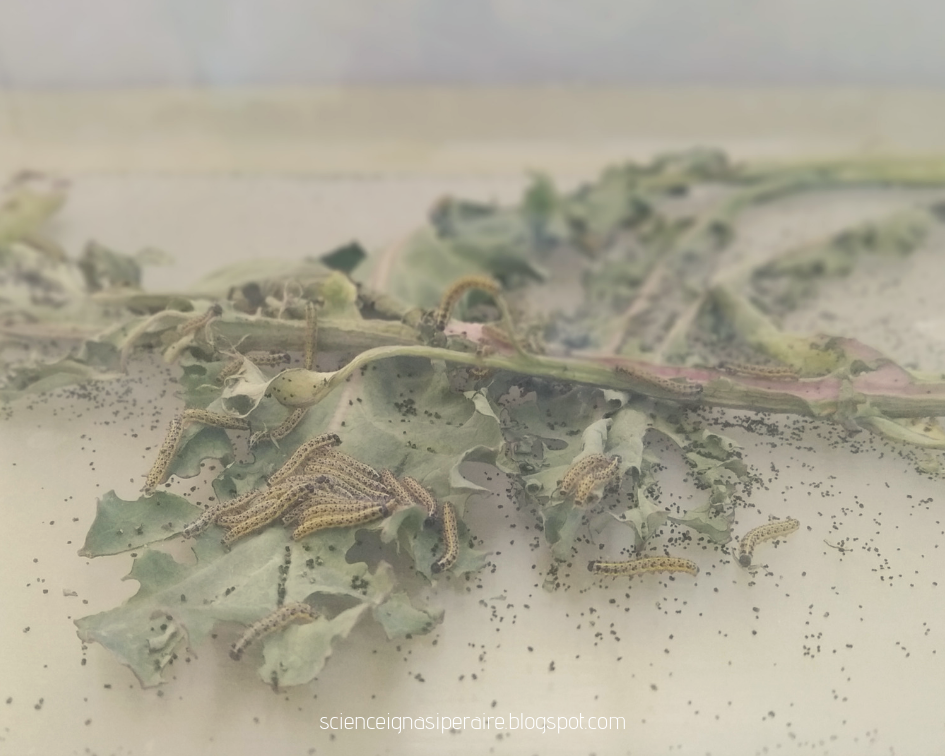
Two days later, lots of tiny caterpillars hatched from the eggs. We realised that they were very hungry because they started to eat from the very beginning:


We observed them every day: they grew super fast.


At his point, we found out that they were caterpillars from a butterfly called Pieris brassicae.
They were "eating machines" (so, if you look at the pictures, you will realise that there were faeces everywhere...haha):


We also discovered that our caterpillars changed their skin several times. Even their head!


Many of us, took a couple of caterpillar at home, in order to keep observing and taking care of them consciously. 

About one month after hatching, these larvae were big enough to start their transformation into a butterfly. This process is called METAMORPHOSIS, and happens to all insects. 
The caterpillars attached themselves at the top of the box and started to build their chrysalis:


And finally, about 15 days later, when the pupas turned darker, butterflies started to emerge:


It has been a great project that has caught pupils of all ages.

We couldn't end our project in any way but setting the butterflies free and wishing them good luck!

Wednesday, 24 April 2019

Electricity (6th Grade)

Hello everyone!

In 6th grade we are studying the ELECTRICITY. Let us show you some of the contents learnt:

We know that all objects have electrical charges. Some charges are positive, PROTONS, and some are negative, ELECTRONS.

Sometimes, the negative charges pass from one object to another. For example:

- By rubbing a pen to a piece of cloth, we pass negative charges from the cloth to the pen. Now the pen is (negatively) electrically charged. So, it can attract small pieces of paper.


- Or by rubbing a balloon to a piece of cloth, we pass negative charges to the balloon. So, it is attracted to other objects:


- But when we approach 2 negatively charged balloons, they repel:


This is STATIC ELECTRICITY.

We also know ho to build an electrical circuit, which carries electrical current:


Finally, we can say if some materials are conductors or insulators after adding them into the circuit. For example:

Wood: insulator.

Pencil lead: conductor.

Pencil lead: conductor.

Salt water: conductor.


Saturday, 23 March 2019

Magnetism (6th Grade)

Good afternoon!

Magnetism is our current learning topic. 6th Grade pupils are experimenting with this force and trying to understand how it works.

Last week we learnt what the magnetic field is: an area around a magnet in which there is a magnetic force. There are invisible lines that go from the north pole of a magnet to the south pole (or the opposite).


By performing an experiment, we could see these invisible magnetic field lines. All we did was spreading out some iron fillings onto a paper, which was laid on a bar magnet. Then, we gently tapped on the paper and...


The next day, we created some temporary magnets:


Sunday, 10 March 2019

STEM Challenge #12: Floating boats

Hello!

3rd Grade pupils have a new STEM Challenge to show you:

"Design and build 2 different floating boats for capacity".


These were the materials provided:


Students, in small groups, had 30 minutes to build 2 different floating boats.


Once they had built the boats, they had to test their capacity, measured with cents.


It was incredible how they managed to build boats designed to hold as much capacity as possible:


A cool look at the sky! (4th Grade)

Hello everyone!

There are many amazing Apps that show us how the sky really looks like.

Fourth grade pupils tried one called Sky Map:


They could find different stars, constellations, planets and even galaxies!


It is very easy to use and you can spend hours and hours investigating the universe. We strongly recommend you to download this app or another (there are many more and most of them are free!).

Wednesday, 6 March 2019

Density experiments (5th Grade)

Hello, everyone!

In 5th Grade we learning about MATTER and its properties: mass, volume and density. 
After calculating the mass and the volume of some solids and liquids, we moved to density. 

"Density is the relationship between mass and volume".

Fist of all, we compared a rock and a piece of cork from similar sizes. We all agreed that they occupy the same space (they have the same volume) but the rock is heavier than the cork (it's got a bigger mass). So, we learnt that the rock was DENSER that the cork.

Then, we moved to liquids. 

1. First, we observed different liquids that have the same volume but weight different.


2. Then, we put the same quantity of water, honey and vegetable oil in 3 different beakers and we poured small objects inside, in order to observe if they floated or sank. Of course, we made predictions first!


"The denser a liquid is, the easier it is for an object to float on it". 

So, we could order the density of the liquids (from most to least):
1. Honey 
2. Water
3. Oil

3. We mixed them up and we saw that liquids with different densities don't mix.


4. Then, we tried to mix hot and cold water, to see if they have different densities (they do!):


5. And we did the same with salty or sweet water:


6. Finally, we poured all the liquids we saw at the beginning of the lesson into a container and we could check that...
"Liquids with different densities don't mix".


Now, it's your turn! Why don't you try it at home?


Thank you Maryam, Rihab, Andreea and Elena to share with us your experiment done at home!

Monday, 25 February 2019

Life and work in the International Space Station (4th Grade)

Hello children!

This is the International Space Station (ISS):


Astronauts from all over the world live in the ISS for a period of time. They study the Earth, the universe and they do experiments.

Sunita Williams

When Sunita Williams was Commander of the International Space Station, she recorded the following video. She made a tour inside the ISS and also she explained how life is there.

It's a highly recommended video, don't miss it!


Friday, 15 February 2019

Fukushima's pictures, after the nuclear disaster from 2011 (6th Grade)

Good morning,

6th Grade pupils are studying Energy. These days, we have been talking about non-renewable energy sources and we came across these pictures from the zone of Fukushima (Japan), which suffered a nuclear disaster some years ago; posted on The Telegraph.


As we can read on the digital version of the newspaper, Photographer and filmmaker Arkadiusz Podniesinki visited abandoned toxic towns and villages that once housed hundreds of thousands of people inside the 20km zone.


Tuesday, 12 February 2019

Non-renewable energy sources (6th Grade)

Hello 6th Grade!

Here you have the 2 videos about FOSSIL FUELS and NUCLEAR ENERGY watched in class this week:
FOSSIL FUELS (in English)

NUCLEAR ENERGY (in Catalan)