Showing posts with label 3rd. Show all posts

Thursday, 10 October 2019

Ear drum model (3rd Grade)

Good afternoon everyone!

Today, with 3rd Grade pupils, we have made an EAR DRUM model (we are learning about the sense of hearing).

The EAR DRUM is a very sensitive organ, inside our ears, which vibrates when sounds pass through it.

With very common materials (a can, a balloon and salt), we built a model of it. To see how it works, you just have to make loud sounds near it and then observe how the salt moves without touching it, just by the vibration of the balloon (=ear drum):


Senses videos (3rd Grade)

Hello 3rd A!

Here there are the videos you asked for! Enjoy them!


How old are your ears? (3rd Grade)

Hello 3rd Grade!

As promised, I share here the video watched in class, in which we tested our sense of hearing.

Try to do it at home and also test your family!


Sunday, 28 April 2019

Butterfly Life Cycle

Hello everyone!

Today we want to share with you a very special project. For the last weeks, we have been observing the life cycle of butterflies:


It all started when our teacher found some eggs on a broccoli leaf and brought them to school. We observed them through the microscope and saw that we had around 50 yellow eggs:


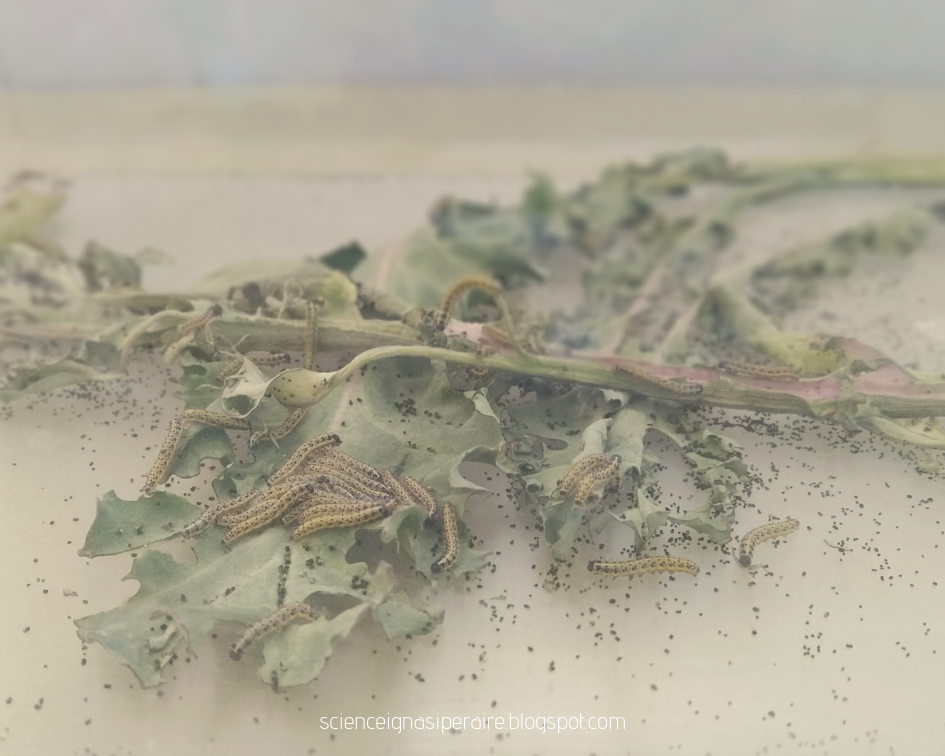
Two days later, lots of tiny caterpillars hatched from the eggs. We realised that they were very hungry because they started to eat from the very beginning:


We observed them every day: they grew super fast.


At his point, we found out that they were caterpillars from a butterfly called Pieris brassicae.
They were "eating machines" (so, if you look at the pictures, you will realise that there were faeces everywhere...haha):


We also discovered that our caterpillars changed their skin several times. Even their head!


Many of us, took a couple of caterpillar at home, in order to keep observing and taking care of them consciously. 

About one month after hatching, these larvae were big enough to start their transformation into a butterfly. This process is called METAMORPHOSIS, and happens to all insects. 
The caterpillars attached themselves at the top of the box and started to build their chrysalis:


And finally, about 15 days later, when the pupas turned darker, butterflies started to emerge:


It has been a great project that has caught pupils of all ages.

We couldn't end our project in any way but setting the butterflies free and wishing them good luck!

Sunday, 10 March 2019

STEM Challenge #12: Floating boats

Hello!

3rd Grade pupils have a new STEM Challenge to show you:

"Design and build 2 different floating boats for capacity".


These were the materials provided:


Students, in small groups, had 30 minutes to build 2 different floating boats.


Once they had built the boats, they had to test their capacity, measured with cents.


It was incredible how they managed to build boats designed to hold as much capacity as possible:


Friday, 8 February 2019

STEM Challenge #11: Frosted forest

Good morning!

Let us introduce a new STEM Challenge, carried out by the students of 3rd Grade:

"Design and build a frosted tree"

Materials:


This Challenge has been adapted from Kerry Tracy and is specially focused on Maths.

Pupils should build a tree with icicles on its branches. These icicles are already given to them: they have a printed sheet full of triangles, which are divided into 3 groups (Equilàter, Isòsceles, Escalè; in Catalan). Moreover, each triangle has some points.


Pupils have to build a tree following these criteria and restrictions:
  • Icicles cannot touch the ground or extend beyond the branch. 
  • There can't be 2 triangles of the same type in one branch.

At the end, each group counted their points! ;)


Wednesday, 23 January 2019

Our body songs (3rd B Grade)

Hi everyone!

And here you can watch some more videos from 3rd B Grade.
We have to congratulate our pupils because they invented great body songs in less than 15 minutes!


STEM Challenge #10: Hibernating bears

Hello!

These short, cold days of winter many animals experience a process called hibernation. For example: squirrels, groundhogs, bats, turtles, snakes or bears.

Previously, they prepare a nest where they "sleep" for a long period of time. Some animals wake during hibernation to eat and relieve themselves, while others sleep through the entire winter.

STEM Challenge #10 engages pupils to:

"Design and build a nest for a hibernating bear".

Materials:

Building time: 40 minutes.

Pupils should consider some criteria and restrictions. For example: nests must have an entrance/exit or bears must be protected from the rain, snow and wind.


Thursday, 17 January 2019

Our body songs (3rd A Grade)

Hello everyone!

We have started the new year full of energy!!! Here you can watch our invented body songs:


Monday, 10 December 2018

STEAM Challenge #9: Thanksgiving!

Hello everyone!

Today we want to share with you an activity we did some weeks ago.

It was Thanksgiving Day, so our teacher engaged us to thank our friends for something they do that makes us happy.

It is a nice activity with a surprising result that you can repeat at home next Thanksgiving Day or at Christmas! Here you have the steps:

First, you must print and colour this star-shaped picture, as beautiful as you can:


Then, you have to cut the star carefully:

After, in the middle of the picture, you have to write a Thanksgiving message addressed to one friend and cover it with the tips of the star:

Finally, put the star on water and...


Wow! It opens so that your friend can read your message!


Body songs (3rd Grade)

Good morning children!

I feel like singing, don't you? ;)

HEAD, SHOULDERS, KNEES and TOES

CHEEKS, CHIN, NECK and BUM

Tuesday, 13 November 2018

STEM Challenge #8: Bridges!

Hello, how are you?

3rd Graders are ready to present you their new STEM Challenge:

"Build a strong bridge that crosses a river and allows boats to sail below it".


Materials: straws, popsicle sticks and 50cm of masking tape.

Building time: 30 minutes.

First iteration pictures:


On the second iteration, we are going to study bridges in depth so that we can build stronger bridges.

Tuesday, 6 November 2018

The Skin (3rd Grade)

Good morning 3rd Grade!

Let's learn about the sense of TOUCH.

The SKIN is the organ of TOUCH.

Do you want to know how it works?


Saturday, 27 October 2018

STEM Challenge #5: Map your brain!

Hi, children!

In 3rd Grade, we are learning about our senses, so this challenge is focused on the sense of TOUCH.

We wanted to know which body parts are more sensitive and we found an experiment developed by Dr. Rebekah Corlew and Theo Walker of the Fitzpatrick Lab at the Max Planck Florida Institute for Neuroscience. This experiment is called The Homunculus Mapper.

https://www.maxplanckflorida.org/fitzpatricklab/homunculus/ 
First, we made this card:


Then, in pairs, we took measurements:
  1. The tested pupil should close their eyes. 
  2. The tester pupil should press 2 points of the card against the skin of the subject and ask if they feel one point or two points. The tested body parts are: HEAD, BACK, ARMS, HANDS, LEGS and FEET.
  3. Start with the largest distance and keep testing smaller and smaller distances until the subject indicates that they feel one point.
  4. Record these distances. 
  5. Enter these numbers on brainmapper.org.


Finally, we entered our results on the web. The more sensitive parts looked larger and the less sensitive parts looked smaller. This is how "our brain thinks we are". For example:


It was an interesting experiment and very easy to do at home ;)


How old are your ears? (3rd Grade)

Hello 3rd Grade!

As promised, I share here the video watched in class, in which we tested our sense of hearing.

Try to do it at home and also test your family!


Friday, 12 October 2018

STEM Challenge #4: Protecting your sight!

Hi, everyone!

After learning about the sense of sight (parts of the eye, functions, etc.), we challenged our 3rd Grade students with a new STEM challenge:

"Create a device to protect your eyes from the sun and sweat". 

Criteria and restrictions:

  • You must be able to see perfectly.
  • You can not touch the device while wearing it.
  • You can only use the materials provided.


Building time: 40 minutes.

Materials:


First day:


Second day:


Friday, 28 September 2018

STEM Challenge #3: Food towers!

Hi, everyone!

We are very happy to show you our STEM Challenge number 3: Food Towers, solved by 3rd Grade pupils. Again, we got the idea out of Feel Good Teaching, by Kerry Tracy.

Students were challenged to build a tower using school supplies, following some criteria. For example: at the top of the tower, there had to be a piece of food; or, towers should be as tall as possible.

Materials provided:


Building time: 30 minutes.


The next week, pupils tried to solve the same challenge again. Clearly, all of the groups improved their towers!


Thursday, 8 June 2017

Parts of a flower (3rd Grade)

Hello!

Third Grade pupils are studying the parts of a flower, and LILIUMS are perfect flowers to do that, because their parts are clearly visible. We strongly recommend you to get some and observe them, using a magnifying glass or, if possible, a microscope. Then, all the parts can be drawn.

LILIUMS:
 STAMENS AND PISTIL:
PETALS, STAMENS AND PISTIL:


 OVARY, OVULES AND STIGMA:
 STIGMA:
 STAMEN: ANTHER AND POLLEN: