Showing posts with label 6th. Show all posts

Tuesday, 5 November 2019

Bones (6th Grade)

Hello children!

Some days ago, pupils were asked to bring bones in class. Attention! These bones had to be cooked, cleaned and frozen, for our safety work.

Once we had all the bones (most of them, chicken bones), we classified them into 3 groups:

LONG - SHORT - FLAT


After that, we broke a bone to see what it has inside: THE BONE MARROW; responsible for making blood cells.


Then, we put some bones in a jar full of white vinegar, and we waited for 2 weeks.


What happened to the bones when we opened the jars after 2 weeks?


We found out that bones could be easily bended! But, why?

Vinegar is an acid, so it dissolves away the calcium in the bones. When the calcium is dissolved, the bone isn't hard.

This is the reason why it is so important to eat calcium (milk, yogurt, cheese,...). The calcium we eat, goes to our bones and makes them stronger.

Sunday, 28 April 2019

Butterfly Life Cycle

Hello everyone!

Today we want to share with you a very special project. For the last weeks, we have been observing the life cycle of butterflies:


It all started when our teacher found some eggs on a broccoli leaf and brought them to school. We observed them through the microscope and saw that we had around 50 yellow eggs:


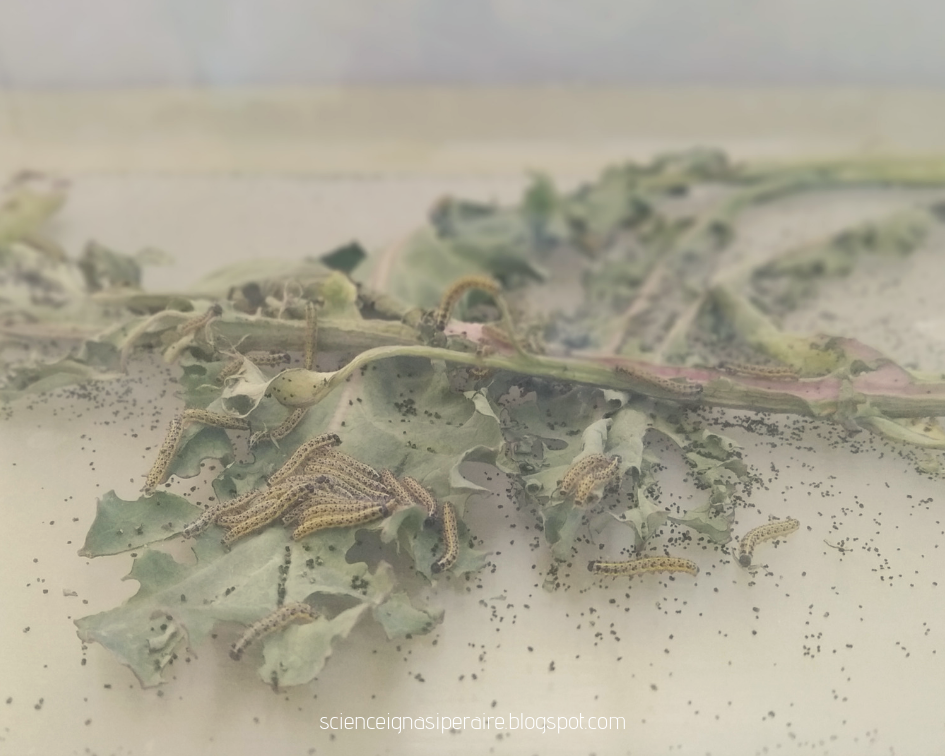
Two days later, lots of tiny caterpillars hatched from the eggs. We realised that they were very hungry because they started to eat from the very beginning:


We observed them every day: they grew super fast.


At his point, we found out that they were caterpillars from a butterfly called Pieris brassicae.
They were "eating machines" (so, if you look at the pictures, you will realise that there were faeces everywhere...haha):


We also discovered that our caterpillars changed their skin several times. Even their head!


Many of us, took a couple of caterpillar at home, in order to keep observing and taking care of them consciously. 

About one month after hatching, these larvae were big enough to start their transformation into a butterfly. This process is called METAMORPHOSIS, and happens to all insects. 
The caterpillars attached themselves at the top of the box and started to build their chrysalis:


And finally, about 15 days later, when the pupas turned darker, butterflies started to emerge:


It has been a great project that has caught pupils of all ages.

We couldn't end our project in any way but setting the butterflies free and wishing them good luck!

Wednesday, 24 April 2019

Electricity (6th Grade)

Hello everyone!

In 6th grade we are studying the ELECTRICITY. Let us show you some of the contents learnt:

We know that all objects have electrical charges. Some charges are positive, PROTONS, and some are negative, ELECTRONS.

Sometimes, the negative charges pass from one object to another. For example:

- By rubbing a pen to a piece of cloth, we pass negative charges from the cloth to the pen. Now the pen is (negatively) electrically charged. So, it can attract small pieces of paper.


- Or by rubbing a balloon to a piece of cloth, we pass negative charges to the balloon. So, it is attracted to other objects:


- But when we approach 2 negatively charged balloons, they repel:


This is STATIC ELECTRICITY.

We also know ho to build an electrical circuit, which carries electrical current:


Finally, we can say if some materials are conductors or insulators after adding them into the circuit. For example:

Wood: insulator.

Pencil lead: conductor.

Pencil lead: conductor.

Salt water: conductor.


Saturday, 23 March 2019

Magnetism (6th Grade)

Good afternoon!

Magnetism is our current learning topic. 6th Grade pupils are experimenting with this force and trying to understand how it works.

Last week we learnt what the magnetic field is: an area around a magnet in which there is a magnetic force. There are invisible lines that go from the north pole of a magnet to the south pole (or the opposite).


By performing an experiment, we could see these invisible magnetic field lines. All we did was spreading out some iron fillings onto a paper, which was laid on a bar magnet. Then, we gently tapped on the paper and...


The next day, we created some temporary magnets:


Friday, 15 February 2019

Fukushima's pictures, after the nuclear disaster from 2011 (6th Grade)

Good morning,

6th Grade pupils are studying Energy. These days, we have been talking about non-renewable energy sources and we came across these pictures from the zone of Fukushima (Japan), which suffered a nuclear disaster some years ago; posted on The Telegraph.


As we can read on the digital version of the newspaper, Photographer and filmmaker Arkadiusz Podniesinki visited abandoned toxic towns and villages that once housed hundreds of thousands of people inside the 20km zone.


Tuesday, 12 February 2019

Non-renewable energy sources (6th Grade)

Hello 6th Grade!

Here you have the 2 videos about FOSSIL FUELS and NUCLEAR ENERGY watched in class this week:
FOSSIL FUELS (in English)

NUCLEAR ENERGY (in Catalan)

Friday, 8 February 2019

Renewable and non-renewable energy sources (6th Grade)

Good morning children!

This week, I strongly recommend you to visit the following website. It is about renewable and non-renewable energy sources. You will be able to hear very clear explanations in Spanish.


Scientist of the month: Ada Lovelace

Hi everyone!

For 6th graders, a new month means a new scientist to discover :)

ADA LOVELACE

Ada Lovelace (originally Augusta Ada Byron) was born on the 10th December 1815 in London. She was a writer and a mathematician. 


She is considered the world's first computer programmer (although computers weren't invented until one hundred years later!!!). 

 In the Science class we have discovered some facts about her interesting life. 

Please, don't forget to watch this video about Ada:

Monday, 10 December 2018

Female and male reproductive systems (6th Grade)

Click on the following links to learn more about each part of the reproductive systems, male and female.

Find the slideshows and click on them to see how the different parts work.

MALE REPRODUCTIVE SYSTEM


FEMALE REPRODUCTIVE SYSTEM

Wednesday, 31 October 2018

(Halloween) STEM Challenge #7: Bones bridge!

Hello!!!

Here there is another (Halloween) STEM Challenge:

"Build the longest and strongest possible BONES BRIDGE."

Pupils were given 25 minutes and the following material:


At first, they found the challenge pretty hard. It was difficult to build a stable bridge and capable of supporting weight.


Pupils needed some extra advice. So, they watched the following video and we talked about it in class:


The next day, all the groups improved their bridges. Look:

6th A Bridges
6th B Bridges

Friday, 12 October 2018

Bones (6th Grade)

Hello children!

Two weeks ago, pupils were asked to bring bones in class. Attention! These bones had to be cooked, cleaned and frozen, for our safety work.

Once we had all the bones (most of them, chicken bones), we classified them into 3 groups:

LONG - SHORT - FLAT


After that, we broke a bone to see what it has inside: THE BONE MARROW; responsible for making blood cells.


Then, we put some bones in a jar full of white vinegar, and we waited for 2 weeks.


What happened to the bones when we opened the jars after 2 weeks?


We found out that bones could be easily bended! But, why?

Vinegar is an acid, so it dissolves away the calcium in the bones. When the calcium is dissolved, the bone isn't hard.

This is the reason why it is so important to eat calcium (milk, yoghurt, cheese,...). The calcium we eat, goes to our bones and makes them stronger.

Monday, 1 October 2018

"Evolution" game (6th Grade)

Hello children!

How are you?

In 6th Grade, we are learning the Musculoskeletal System (bones, muscles, joints, ligaments, tendons, etc.). Isaac, a pupil from 6th B, suggested us an online game which is closely related to this topic.

This game is called Evolution:


You can use the web to play: CLICK HERE

Or download its App, either on Google Play: CLICK HERE, or iTunes: CLICK HERE


Monday, 24 September 2018

STEM Challenge #1: Fruit race!

Hello children!

This year we're going to learn with STEM Challenges!

The idea for the first STEM Challenge for 6th Grade has been taken from the great Kerry Tracy, from Feel Good Teaching (thanks for sharing ;)), and is called FRUIT RACE.

Materials:


Students were challenged to build a fruit-balanced device, in teams of 4. This device had to be put on their heads in order to participate in a teams race. Pupils could not touch the fruit while racing.

First-iteration devices

It has been a great opportunity to introduce engineering activities in the primary class.

It is good to do a second iteration, so that student can reflect and improve their initial machines:


Second-iteration devices
And they were our winners in the race:


Congratulations!!!