Showing posts with label 5th. Show all posts

Tuesday, 5 November 2019

Blood components (5th Grade)

Hello!

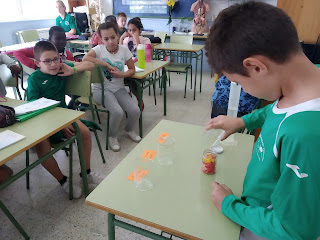
In 5th Grade, we made a blood model, in order to see its different components:


We used some candy for:

- RED BLOOD CELLS, which carry the oxygen and the carbon dioxide thorough the body. They make 40% of the blood, so we made sure we added plenty of them.

- WHITE BLOOD CELLS, which protect our bodies from bacteria and microbes. There are fewer that the previous ones, so we used only a little of them.

- PLATELETS: which stop the bleeding in a wound.

- PLASMA: we used water but, in fact, we might have used another liquid because plasma is yellow.


It was easy and very visual. Are you going to do it at home using other ingredients???

Sunday, 28 April 2019

Butterfly Life Cycle

Hello everyone!

Today we want to share with you a very special project. For the last weeks, we have been observing the life cycle of butterflies:


It all started when our teacher found some eggs on a broccoli leaf and brought them to school. We observed them through the microscope and saw that we had around 50 yellow eggs:


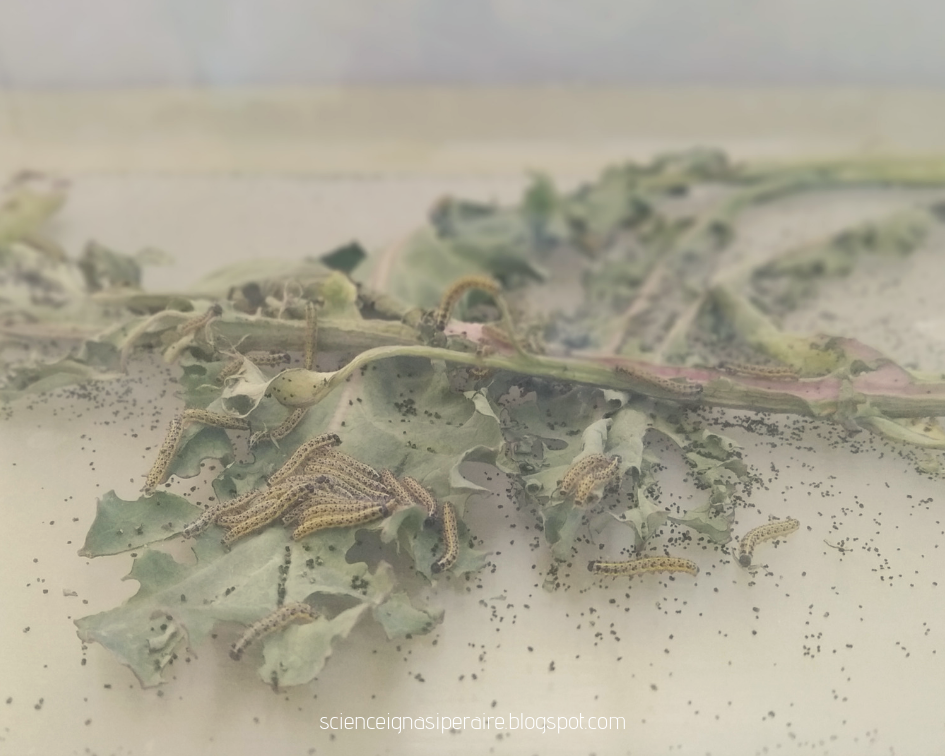
Two days later, lots of tiny caterpillars hatched from the eggs. We realised that they were very hungry because they started to eat from the very beginning:


We observed them every day: they grew super fast.


At his point, we found out that they were caterpillars from a butterfly called Pieris brassicae.
They were "eating machines" (so, if you look at the pictures, you will realise that there were faeces everywhere...haha):


We also discovered that our caterpillars changed their skin several times. Even their head!


Many of us, took a couple of caterpillar at home, in order to keep observing and taking care of them consciously. 

About one month after hatching, these larvae were big enough to start their transformation into a butterfly. This process is called METAMORPHOSIS, and happens to all insects. 
The caterpillars attached themselves at the top of the box and started to build their chrysalis:


And finally, about 15 days later, when the pupas turned darker, butterflies started to emerge:


It has been a great project that has caught pupils of all ages.

We couldn't end our project in any way but setting the butterflies free and wishing them good luck!

Wednesday, 6 March 2019

Density experiments (5th Grade)

Hello, everyone!

In 5th Grade we learning about MATTER and its properties: mass, volume and density. 
After calculating the mass and the volume of some solids and liquids, we moved to density. 

"Density is the relationship between mass and volume".

Fist of all, we compared a rock and a piece of cork from similar sizes. We all agreed that they occupy the same space (they have the same volume) but the rock is heavier than the cork (it's got a bigger mass). So, we learnt that the rock was DENSER that the cork.

Then, we moved to liquids. 

1. First, we observed different liquids that have the same volume but weight different.


2. Then, we put the same quantity of water, honey and vegetable oil in 3 different beakers and we poured small objects inside, in order to observe if they floated or sank. Of course, we made predictions first!


"The denser a liquid is, the easier it is for an object to float on it". 

So, we could order the density of the liquids (from most to least):
1. Honey 
2. Water
3. Oil

3. We mixed them up and we saw that liquids with different densities don't mix.


4. Then, we tried to mix hot and cold water, to see if they have different densities (they do!):


5. And we did the same with salty or sweet water:


6. Finally, we poured all the liquids we saw at the beginning of the lesson into a container and we could check that...
"Liquids with different densities don't mix".


Now, it's your turn! Why don't you try it at home?


Thank you Maryam, Rihab, Andreea and Elena to share with us your experiment done at home!

Thursday, 31 January 2019

11 Fascinating Fungi AroundThe World (5th Grade)

Hello boys and girls!!!

In 5th Grade, we are learning about the 5 kingdoms of living things. We found these fascinating pictures of Fungi around the world, from the website Twisted Sifter (which is cool!). Have a look!

1. BLUE MILK MUSHROOM (Lactarius indigo)

2. BITTER OYSTER (Panellus stipticus)

3. GOLDEN JELLY FUNGIS (Tremella mesenterica)

4. THE WRINKLED PEACH (Rhodotus palmatus)

5. VIOLET CORAL (Clavaria zollingeri)

6. ROUNDED EARTHSTAR (Geastrum saccatum)

7. ANEMONE STINKHORN (Aseroe rubra)

8. UMBER-BROWN PUFFBALL (Lycoperdon umbrinum)

9. PIXIE'S PARASOL (Mycena interrupta)

10. THE BLACK MOREL (Morchella conica)


11. FLY AGARIC (Amanita muscaria)


Wednesday, 23 January 2019

Oberving a macro cell: an egg! (5th Grade)

Hello boys and girls!

As you know, 5th Grade pupils are learning about the cells.

Most of the cells are so tiny that are invisible to the human eye; we need a microscope to see them.

But, if we look at an unfertilized egg, we can see a cell! In fact, the YOLK (yellow part) is a single cell.

We could identify:

  • the cytoplasm (yellow)
  • the membrane (by smashing soflty the yolk)
  • the nucleus (a white spot in the cytoplasm)


Monday, 29 October 2018

(Halloween) STEM Challenge #6: Spider-catcher!

Hello, everyone!

He-heeeee, it's Halloweeeen!!!!!

STEM Challenges are always great. They help develop our students' building skills, group-work abilities or design thinking, among other capacities.

This week, taking advantage of Halloween, we decided to challenge our pupils the following way:

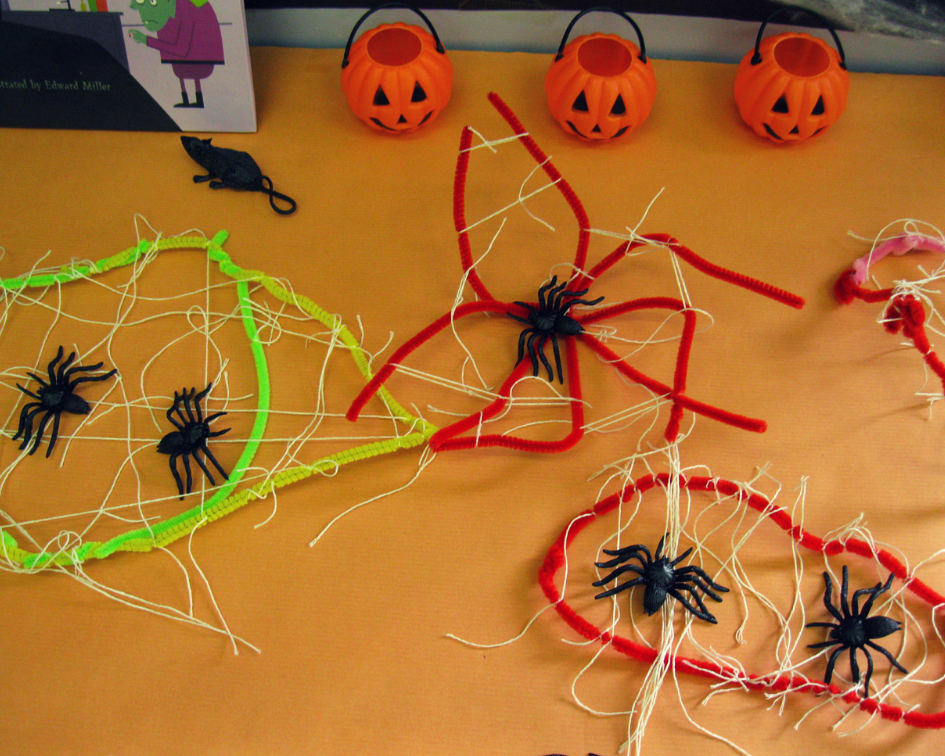
"Design and build a SPIDER CATCHER".


We can assure that it is more difficult than it seems!

Pupils were given the following material:


In small groups, they had 20 minutes to build a spider catcher with a surface of 25x25cm. 


Once they got the Catcher (or after 20 minutes), a member of another group should throw spiders all over the device. Then, pupils should raise it carefully and see how many spiders remained caught:


Monday, 8 October 2018

Blood components (5th Grade)

Hello!

In 5th Grade, we made a blood model, in order to see the different components of blood:


We used some candy for:

- RED BLOOD CELLS, which carry the oxygen and the carbon dioxide thorough the body. They make 40% of the blood, so we made sure we added plenty of them.

- WHITE BLOOD CELLS, which protect our bodies from bacteria and microbes. There are fewer that the previous ones, so we used only a little of them.

- PLATELETS: which stop the bleeding in a wound.

- PLASMA: we used water but, in fact, we might have used another liquid because plasma is yellow.


It was easy and very visual. Are you going to do it at home using other ingredients???