Thursday, 31 May 2018

Planes and helicopters (6th Grade)

Hello!

Our 6th Grade pupils continue with their Engineering lessons.

Who thought that building an aeroplane or a helicopter was going to be difficult? Read the following post in order to build these machines in less that 10 minutes!

PLANES
You only need a piece of paper, a straw, scissors and adhesive tape. 


HELICOPTERS
Material needed: a piece of paper, scissors and a paper clip.

Instructions:


 They even organised flying competitions!


Catapults (6th Grade)

Hello everyone!

In 6th Grade, we learn about the Simple Machines. So, we found it a good opportunity to start having some Engineering lessons. To start with, we decided to build a type of LEVER (our 1st studied simple machine) and we chose a CATAPULT:


It was easy and entertaining. We followed the instructions in this video from Experciencia, an amazing STEM website (in Spanish):


Here are some pictures of our catapults:


Friday, 6 April 2018

Lemon batteries (6th Grade)

Good morning!

Yesterday, we made a watch work with a very special battery: A LEMON!!!


There are many variations of this experiment. You need a piece of COPPER (for example, a 0,05€ coin), a piece of ZINC (for example, a screw or nail), WIRES, an object that needs electricity to work (for example, a LED) and LEMONS (but also grapes, potatoes,...).


Electricity (6th Grade)

Hello everyone!

In 6th grade we have studied ELECTRICITY. Let us show you some of the contents learned:

We know that all objects have electrical charges. Some are positive, PROTONS, and some are negative, ELECTRONS.

Sometimes, the negative charges pass from one object to another. For example:

- By rubbing a pen to a piece of cloth, we pass negative charges from the cloth to the pen.


Now the pen is (negatively) electrically charged. So, it can attract small pieces of paper.


- Or by rubbing a balloon to a piece of cloth, we pass negative charges to the balloon. So, it is attracted to other objects:


This is STATIC ELECTRICITY.

We also know ho to build an electrical circuits. which carries electrical current:


Finally, we can say if some materials are conductors or insulators after adding them into the circuit:


Thursday, 5 April 2018

Temporary magnets (6th Grade)

Hello 6th grade!

Here there is a selection of your temporary magnets (Remember: metallic objects that get magnetic properties when they are in direct contact with a magnet).


Beautiful sculptures!!! :)

Scientist of the month: Galileo Galilei

Good afternoon 6th Grade!

Let's meet the April's Scientist of the Month...

GALILEO GALILEI


Galileo Galilei was born on 15th February 1564 in Pisa, Italy. He is considered the Father of Modern Science, for all the discoveries, theories and experiments he made.


He studied Natural Forces and he was the first person to publish his astronomic observations through a telescope. He discovered:

- The Milky Way is made of many stars.
- The moon has got mountains and craters.
- He saw four moons of Jupiter (called the Galilean Moons)
- Sunspots (dark areas of the Sun)
- Planet Venus has light and dark phases.

So, he concluded that THE SUN IS AT THE CENTRE of the Solar System and NOT the Earth.

Unfortunately, the Church didn't like his opinions and arrested him.


Please, don't forget to watch this video about Galileo Galilei:


Wednesday, 14 March 2018

Stephen Hawking 1942 - 2018

Stephen Hawking, considered one of the world's most brilliant minds, died today at the age of 76.


He was a great scientist, who studied the laws of the universe, especially black holes. He revealed that black holes have a temperature and produce radiation (the Hawking Radiation).

He wrote many popular books to explain complex scientific ideas, for example: A Brief History of Time is a bestseller.

His friends and colleagues from the University of Cambridge paid tribute to Professor Stephen Hawking with the following video:


For extra information:
- Visit his Official Website HERE
- Ten Facts About Spehen Hawking (national Geogrpahic Kids): HERE

Thursday, 8 March 2018

Scientist of the month: ADA LOVELACE

Hi everyone!

For 6th graders, a new month means a new scientist to discover :)

ADA LOVELACE

Ada Lovelace (originally Augusta Ada Byron) was born on the 10th December 1815 in London. She was a writer and a mathematician. 

She is considered the world's first computer programmer (although computers weren't invented until one hundred years later!!!). 

 In the Science class we have discovered some facts about her interesting life. 


Please, don't forget to watch this video about Ada:

Saturday, 3 March 2018

Science news: Super-colony of Penguins Discovered in Antarctica

Scientists of the world are very happy because a mega-colony of  Adelie Penguins were discovered on the Antarctica's Danger Islands.

Scientist found more than 1,5 million of these birds and they used a drone to record the following video:


The objective now is to study these penguins and protect them from human activity. 

Thursday, 1 March 2018

Magnetism activities (6th Grade)

Hello everyone!

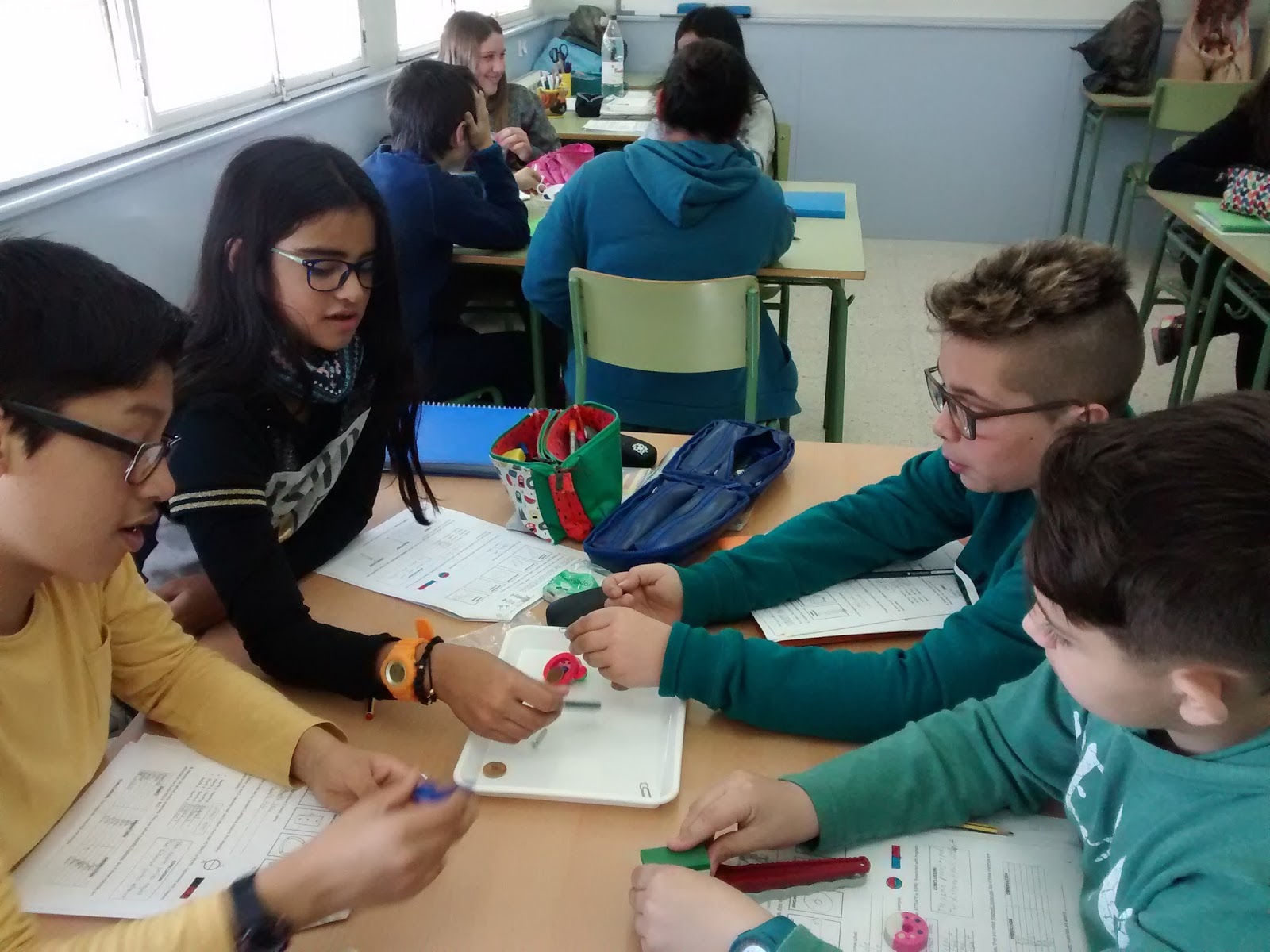
In 6th grade, we are experimenting with magnets. We had some entertaining lessons, in which we could explore the interesting world of magnetism.

We saw, drew and used magnets of different shapes:


We recognized the two different magnetic poles every magnet has, North and South, and we realized that if we put two magnets together, they can ATTRACT or REPEL. Opposite poles attract; the same poles repel.

ATTRACT:

REPEL:

We could also see the magnetic field lines after spreading out some iron fillings onto a paper, which was laid on a bar magnet.


We couldn't avoid playing with the iron fillings for a while... ;)


Magnetism videos (6th Grade)

Hello children!

You can watch the following Magnetism Videos at home, in order to revise what we learned in class: